

Applied AI
Drafted, reviewed, signed.
The system writes the first draft from your records. Your specialist corrects and signs it. Every edit is kept.
Report, draft 2
Background rhythm is well organised at 9–10 Hz posteriorly, reactive to eye opening.
Intermittent slowing over the left temporal region.No focal slowing is observed.
Signed by the reporting consultant
What this usually looks like before we start.
- Your most expensive hours go into writing things up, not deciding them.
- The backlog grows faster than you can hire specialists to clear it.
- Nobody will put their name to output they cannot trace.
What we build.
Drafting from your own records
The draft is assembled from documents you already hold and cites them, so every line can be checked against its source.
Review and sign-off, designed first
The person who signs is named in the system, and the edit history is kept, so accountability is a record rather than an assumption.
An evaluation before anything is committed
Two weeks on your own documents answers the accuracy question with your data instead of with a demo.
Models trained on your examples
Where off-the-shelf AI falls short on your documents, formats or languages, including Urdu, we train and validate a model on your own examples.
Report, draft 2
Background rhythm is well organised at 9–10 Hz posteriorly, reactive to eye opening.
Intermittent slowing over the left temporal region.No focal slowing is observed.
Signed by the reporting consultant
Drafting from your own records
The draft is assembled from documents you already hold and cites them, so every line can be checked against its source.
Report, draft 2
Background rhythm is well organised at 9–10 Hz posteriorly, reactive to eye opening.
Intermittent slowing over the left temporal region.No focal slowing is observed.
SignedSigned by the reporting consultant
Review and sign-off, designed first
The person who signs is named in the system, and the edit history is kept, so accountability is a record rather than an assumption.
Purchase approval
- RaisedSite office
- CostedEstimating
- ApprovedFinance
- OrderedPurchasing
- ReceivedStores
An evaluation before anything is committed
Two weeks on your own documents answers the accuracy question with your data instead of with a demo.
Migration rehearsal
Set Old system New system Customers 4,182 4,182 Open invoices 917 917 Opening balances 2,412,600 2,412,600 Every set reconciles
Models trained on your examples
Where off-the-shelf AI falls short on your documents, formats or languages, including Urdu, we train and validate a model on your own examples.
Ask the warehouse
Which product lines grew fastest this quarter?
- Cartons+92%
- Sheets+61%
- Trays+44%
- Inserts+28%
Show the query it ran
select line, round(100.0 * (q3 - q2) / q2, 1) as growth
from product_quarter
where fy = 2026
order by growth desc
How we work on it
- 01Describe the document your specialists dread writing.
- 02A two-week evaluation on your own records, before anything is committed.
- 03A working demo every two weeks, with the review step built first.
- 04Live, with the time per document measured before and after.
- 05We run it, retrain it, and keep the audit trail intact.
Healthcare
A hospital network clears a three-week EEG backlog.
EEG report drafting time cut by 70%, and a three-week backlog cleared.
An AI reporting pipeline that drafts EEG reports for neurologists to review and sign, cutting drafting time by 70%.
Read the case study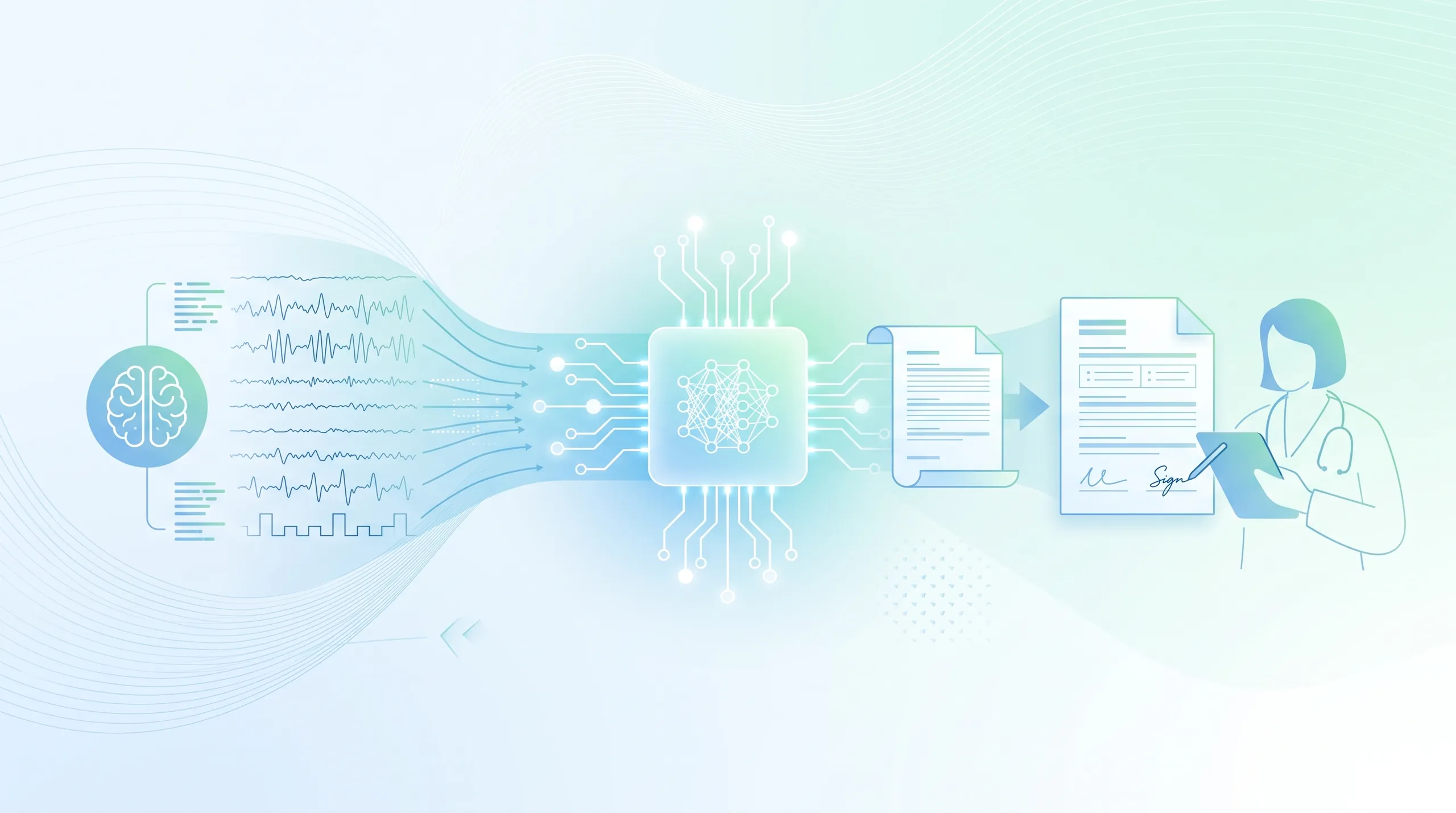



Tell us about the report your specialists dread writing.
Describe it in plain language. We will respond with a proposed architecture, a first milestone and the key risks.
We respond within one business day. If we are not the right fit, we will tell you.